
Ai Art
The Evolution of AI Art


Hey there, art and tech enthusiasts! 🎨🤖 Today, we’re taking a trip down memory lane to explore the fascinating evolution of AI art. From its humble beginnings to the stunning masterpieces we see today, AI art has come a long way. Let’s trace its history, highlight key milestones, and see how the technology has evolved over time. Ready? Let’s dive in! 🚀
The Early Days: Humble Beginnings 🛤️
The journey of AI art began in the mid-20th century, long before the term “AI art” was even coined. Early experiments in computer-generated art were rudimentary but groundbreaking. Artists and computer scientists started exploring the potential of algorithms to create visual art.
Read more: https://medium.com/@datadrip369/the-evolution-of-ai-art-ea61db726aba


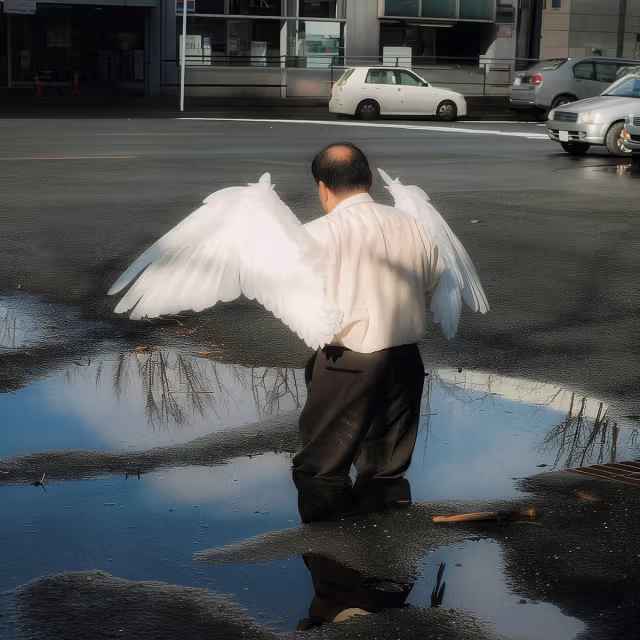
“No, I hate Ai,” writes @yorxfoly on Instagram. “Proud people sharing images that their computer spat out and thinking they have any sort of artistic vision, makes me sick.”
He and others with a split of opinions on the use of generative artificial intelligence (AI) to make art are reacting to a post by Charlie Engman sharing an opinion piece he has written for Art in America. Titled “You Don’t Hate AI, You Hate Capitalism”, the New York-based artist’s article sets out to reframe the reductive and often binary debate about AI art.
More reflective than derivative
The thrust of it is that we have been thinking about AI all wrong. Criticism of the technology—or, rather, hatred of AI—centres around the idea that it is derivative, and that it steals from artists. Engman argues that AI merely reflects our own prejudices and desires, and that it lays bare the myths of the art market and how value is shrouded in mystique, and questionably attributed to originality—which he says is bogus.
We are not asking wider questions about who else is exploited by large tech firms in the process of making content, he says, and the same is often true of the art world. “Whom do they enrich, and whom do they impoverish?” he quotes from the 2017 manifesto of Logic(s) magazine.
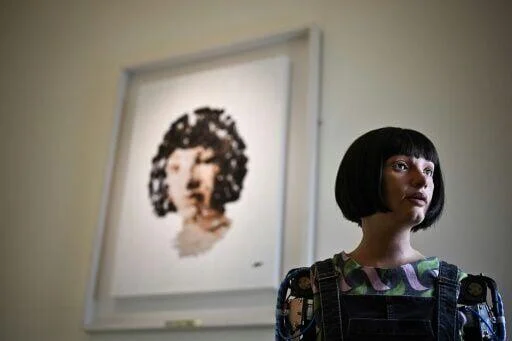
The robot artist Ai-Da, a humanoid powered by artificial intelligence, will be the first of its kind to have a painting sold at a major auction house, organisers said Wednesday.
The work, due to go under the hammer online at Sotheby’s next month, is described as a “haunting” portrait of the English mathematician Alan Turing, considered one of the fathers of modern computing.
Entitled “AI God”, the 2.2 metre (7.5 ft) high portrait is expected to fetch between £100,000 and £150,000 ($130,000 and $196,000).
The online sale, featuring a range of digital art forms, would explore the intersection between art and technology, according to Sotheby’s.
The ultra-realistic robot is designed to resemble a human female with a face, large eyes and a brown wig and is one of the most advanced in the world.
Did the art market embrace AI this year? Actually, did you even?
Because for all its ubiquity in the ‘discourse,’ aside from the (annoying) new AI summaries on Google search results, I don’t feel like I notice Artificial Intelligence in day-to-day life all that much. And I’ve only sporadically used it. (But I know talking to people who teach students or who hire for job roles, it very much is making itself known!)
I think part of the issue is that there’s a lot of noise around AI. It’s hard to distinguish between the reality, and the hype. This is especially true in the art world. Is AI going to be a genuine game-changer, or is it overblown by well-paid PR professionals?
This is where journalist Jo Lawson-Tancred comes in. Her new book — AI and the Art Market — aims to demystify AI’s relationship to art, and to offer a measured view of the current landscape. It’s the first book to offer an approachable introduction to AI for art-market professionals, and it hopes to better equip them with info on how to work with AI in an art-world context. Because again, despite the fanfare, we are all relative novices.
Read more: https://www.maxwellmuseums.com/post/ai-in-the-art-market-jo-lawson-tancred-new-book-interview


